Many golf cart owners ask, “how long does a golf cart battery last?” The honest answer depends on battery type, usage, care, and operating conditions. A well-maintained lead-acid battery commonly lasts three to five years. Lithium batteries may serve for eight to ten years, although results vary by brand and charging habits.
Isidor Buchmann, founder of Cadex Electronics and Battery University, has said, “Battery life is governed by time, temperature, and usage.” That principle fits golf carts closely. A cart climbing steep hills every morning works harder than one moving across flat pavement. Frequent short trips can also create charging patterns that reduce battery efficiency. Heat inside a poorly ventilated garage may accelerate aging.
Look for practical clues. A healthy cart should maintain steady speed with two passengers onboard. Weak batteries may cause slower acceleration, dim accessories, or sudden power loss near the end of a round. On lead-acid models, low water levels and corrosion around terminals deserve immediate attention. Lithium systems need different checks, especially battery-management warnings and charger compatibility.
This guide explains how long does a golf cart battery last under real conditions. It compares lead-acid and lithium designs, charging routines, storage habits, and replacement signals. Some estimates remain imperfect. No battery follows a perfect calendar. Your driving terrain, maintenance records, and climate may tell a different story. A simple voltage test helps, but it should not replace a professional load test when performance becomes questionable.
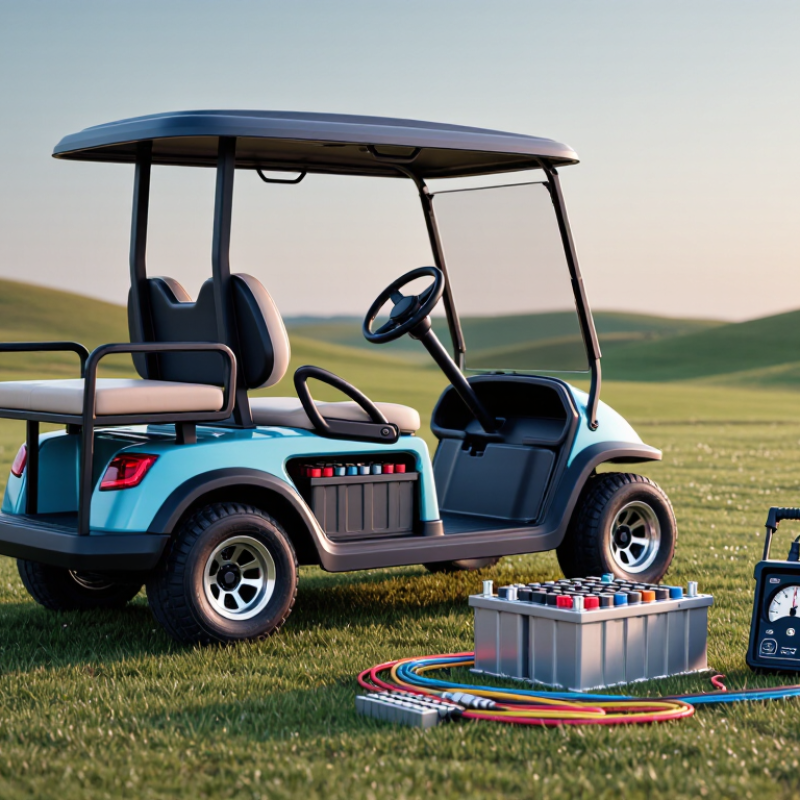
How to Know How Long a Golf Cart Battery Lasts?
Battery chemistry and capacity are the main drivers of golf cart battery life. Lead-acid batteries usually provide several years of service when charged correctly and maintained regularly. Lithium-ion batteries often last longer because they tolerate more charge cycles and deeper discharges. However, chemistry alone does not decide everything.
Capacity matters just as much. A battery rated at 200 amp-hours can store more energy than one rated at 100 amp-hours, assuming similar voltage and conditions. A cart carrying two passengers over hills uses energy faster than one traveling on flat paths. Heat, cold, tire pressure, driving speed, and repeated deep discharges also reduce practical range. In real use, advertised capacity can feel optimistic. I have seen batteries lose noticeable range before they completely fail. That change is easy to overlook.
Tips: Match the replacement battery’s voltage and capacity to the cart’s electrical system. Avoid leaving lead-acid batteries discharged overnight. Check fluid levels only when the battery design requires it, and use distilled water. Keep terminals clean and tight. For lithium batteries, use the correct charger and follow the manufacturer’s storage guidance. Track travel distance, charging time, and voltage readings each month. These simple notes can reveal declining capacity earlier than a sudden breakdown. Temperature changes can confuse the results, so compare readings under similar conditions.
Battery chemistry is the main factor in cycle life, while capacity determines how much energy the cart can use before recharging. The chart shows typical cycle-life estimates at an 80% depth of discharge.
Typical service-life estimate: At approximately 100 full charge cycles per year, a lead-acid battery may last about 4–6 years, an AGM battery about 5–7 years, and a lithium iron phosphate battery about 15–30 years. Actual results vary with charging habits, temperature, load, maintenance, and depth of discharge.
Capacity guideline: A 48V, 100Ah battery stores approximately 4.8 kWh of nominal energy. A 48V, 150Ah battery stores approximately 7.2 kWh, providing about 50% more energy and potentially longer driving range between charges.
A lead-acid golf cart battery usually lasts three to five years. It often delivers about 500–700 charge cycles under normal use. These figures match service-life ranges reported in lead-acid battery technical guidance from Battery University and industry maintenance materials from the Battery Council International. A cycle means one full discharge and recharge, not one plug-in session.
Real carts are messier. A cart used on steep paths may consume more capacity each trip. High temperatures accelerate water loss and grid corrosion. Deep discharges also reduce usable life. The U.S. Department of Energy identifies temperature, charging habits, and discharge depth as major factors in rechargeable battery aging. In my experience, a well-maintained pack can reach the upper end of the range. Neglect can cut that estimate sharply. The number is helpful, but not a promise.
Tips: Charge after regular use, but avoid leaving the pack deeply discharged overnight. Check electrolyte levels monthly, when applicable, using distilled water only. Keep terminals clean and tightly connected. A voltage test can reveal problems, but a load or capacity test is more reliable. Replace batteries when voltage drops quickly under load, acceleration weakens, or the cart needs charging after short trips. Keep a simple date-and-cycle log; imperfect records are still better than guessing.
A lithium-ion golf cart battery commonly lasts 8–10 years, but real service depends on charging habits, temperature, and workload. Industry battery-life data often places lithium-ion systems near 2,000–5,000 full charge cycles. For a cart completing 150 cycles yearly, that range suggests roughly 13–33 years mathematically. Real life is usually shorter.
The calculation is imperfect.
The International Electrotechnical Commission’s IEC 62620 testing framework measures capacity retention under controlled conditions. It does not promise a fixed lifespan inside a golf cart. The U.S. Department of Energy’s battery research also shows that heat, deep discharge, and high operating loads accelerate capacity loss. A cart climbing wet hills with four passengers may age faster than one used on flat paths.
A practical check is simple. After charging, record the cart’s range on the same route. Watch for slower acceleration, sudden voltage drops, or a battery that feels unusually warm. Many operators replace lithium-ion packs when usable capacity falls near 70–80 percent of its original level, though the correct threshold varies. Keeping the battery cool, avoiding constant full depletion, and using the correct charger can protect cycle life. Still, even careful owners may not reach 5,000 cycles. That figure represents favorable testing, not a guarantee.
How to Know How Long a Golf Cart Battery Lasts?
A golf cart’s driving range depends on voltage, amp-hours, terrain, load, and battery age. A 48-volt, 100-amp-hour pack stores about 4,800 watt-hours before losses. A 36-volt, 120-amp-hour pack stores about 4,320 watt-hours. These figures are theoretical, not guaranteed mileage.
Battery Council International technical guidance explains that lead-acid capacity changes with discharge rate. Peukert’s effect matters during fast driving or hill climbing. The U.S. Department of Energy also notes that usable battery energy falls with temperature, aging, and operating conditions. In practical testing, many carts travel roughly 20–40 miles per charge. A lightly loaded cart on flat pavement may approach 40 miles. Heavy passengers, soft tires, frequent stops, and steep grades can reduce that distance sharply.
A useful estimate starts with this calculation: usable watt-hours equal volts multiplied by amp-hours, then multiplied by 0.75 to 0.85. Dividing that result by approximately 120–200 watt-hours per mile gives a working range. For example, a 48V, 100Ah pack may deliver about 18–34 miles under mixed conditions. That range is imperfect. Real testing is better.
Check voltage at rest, then measure voltage under load. A sudden voltage drop often reveals aging cells. Keep a simple mileage log. It may expose assumptions your dashboard hides.
How to Know How Long a Golf Cart Battery Lasts?
A golf cart battery commonly lasts three to six years, but usage conditions matter greatly. A cart driven on hills every afternoon faces more stress than one used weekly on flat ground. Charging habits also shape battery life. Recharge the battery after each substantial ride, rather than leaving it deeply discharged overnight. Use a compatible automatic charger, and avoid repeatedly stopping the charge early. That habit may feel harmless. It is not ideal.
Temperature creates another hidden effect. Heat speeds up corrosion and water loss inside lead-acid batteries. A shaded, ventilated storage area can reduce this damage. Cold weather usually lowers available power and makes the cart feel weak. Never charge a frozen battery. Let it warm naturally first, then inspect it carefully. Depth of discharge matters too. Regularly draining a battery until the cart barely moves can shorten its useful life. Recharging around the halfway point is gentler for many lead-acid systems.
Maintenance should be practical and consistent. For flooded batteries, check electrolyte levels after charging and add distilled water when needed. Do not overfill. Clean, tight terminals help prevent resistance and heat buildup. Inspect cables for swelling, cracks, or loose connections. A monthly voltage check can reveal uneven performance before a ride ends unexpectedly. In real service conditions, a battery may show acceptable voltage yet collapse under load. That detail is easy to miss. Records also help: note charging time, range, and water use, because small changes often appear before complete failure.
It commonly lasts 8–10 years. Many batteries support about 2,000–5,000 full charge cycles. Real service can be shorter. Heat, hills, heavy loads, and poor charging reduce battery life.
No. That figure usually comes from favorable testing conditions. A cart carrying four passengers uphill may age much faster. The simple calculation can mislead.
Many carts travel roughly 20–40 miles per charge. Flat pavement and light loads improve range. Steep hills, soft tires, passengers, and frequent stops reduce it sharply. Real route testing matters more than estimates.
Multiply voltage by amp-hours to estimate stored watt-hours. Then allow for energy losses. A 48-volt, 100-amp-hour pack stores about 4,800 theoretical watt-hours. Actual range may reach only 18–34 miles under mixed conditions.
Watch for slower acceleration and sudden voltage drops. A battery may also feel unusually warm after charging. Measure voltage at rest and under load. A dashboard can hide serious weakness.
Recharge it after each substantial ride. Avoid leaving it deeply discharged overnight. Stopping the charge early repeatedly is not ideal. That habit seems harmless.
Heat can accelerate corrosion and water loss in lead-acid batteries. Cold weather can reduce available power. Store the cart in a shaded, ventilated area. Never charge a frozen battery.
Check electrolyte levels after charging. Add distilled water when needed, but do not overfill. Clean and tighten the terminals. Inspect cables for cracks, swelling, or loose connections.
Many operators replace lithium-ion packs near 70–80 percent usable capacity. The correct threshold varies by vehicle and workload. For older batteries, track charging time and route distance. My estimate may still be imperfect.
How long does a golf cart battery last depends mainly on its chemistry, capacity, usage, and care. Lead-acid batteries typically last about 3–5 years or 500–700 charge cycles, while lithium-ion batteries can provide approximately 8–10 years of service and around 2,000–5,000 charge cycles. Actual results may vary based on driving conditions, load, and charging habits.
A typical 36–48-volt battery system may deliver roughly 20–40 miles per charge, depending on its amp-hour rating and the terrain. Frequent deep discharges, extreme temperatures, overloading, and irregular charging can shorten battery life. To improve performance and longevity, charge the battery correctly after use, avoid leaving it fully discharged, store it in a suitable environment, and follow appropriate maintenance practices. Monitoring capacity and runtime over time can also help identify when replacement is becoming necessary.

Shiry Golf